I've recently been revisiting the Soldersmoke Podcast. I remember listening to it in its early days, and on and off in the intervening years. I didn't realize that it's been running no for over 20 years!
Before I started to listen to the more recent episodes I thought I'd go back and find the early ones,
I've been mulling over my real interests in amateur radio (again) and it's still firmly in the realm of HF and CW. And I've always had more fun playing with simple stuff and QRP.
Pros of QRP
With QRP
you don't need to worry about huge DC supply currents and suitable wiring sizes, and high current PSUs.
you don't need to worry about the ratings of components as much - lower voltage capacitors, smaller toroidal cores. Everything is much easier (and cheaper).
you don't need to worry about high RF levels in the shack - or adjacent to the antenna (thinking EMF safety etc.)
While surfing the interwebs looking for interesting radio content I came across a brilliant website that has scans of THOUSANDS of old radio-related material.
There are trade journals, catalogues, magazines from all parts of the world. It must be a massive undertaking to create and maintain, and to source the material and scan it.
I found almost the complete set of Short Wave Magazine issues going back to the pre-war period! There are also lots and lots of other great magazines.
Short Wave Magazine is of particular importance to me. When I was first getting interested in Short Wave Listening and Amateur Radio as a teenager in the early 1980s I read Short Wave Mag (SMW) and Practical Wireless.
But the thing that cemented my whole outlook on what Amateur Radio is (or should be) was a big pile of SWMs from the 60s and 70s that I was given.
My dad had a friend who turned out to be a long-time SWL and when I expressed an interest in radio my Dad took me on a visit. That was the first time I heard a decent HF receiver (from memory a Trio of some sort, 70s vintage?). I had a nasty Realistic DX100L at the time which was a nightmare to tune in SSB/CW (but still gave me great enjoyment).
More important than hearing his radio (I remember it had a Partridge Joystick antenna attached, propped up in his bedroom, where the radio sat in pride of place on a small table) was the pile of old (they were old and outdated even then) SWMs to read and learn from.
I saw black and white pictures of simple radio shacks, lots of homemade equipment. Sheds and attics full of "proper" radios. Articles about making and modifying transmitters and receivers. Valves and some transistor stuff.
I got the understanding that Amateur Radio was a technical hobby that required you to build stuff. To understand how it works. To "get your hands dirty" and know which end of a soldering iron to hold.
I treasured the small bundle (SWM was a small-form-factor magazine until the 1990s(?) when it went to a "normal" magazine format) of gems from the hey-day of amateur radio. That period when valves were still king, but new technology was coming. Transistors were common, some small IC projects were appearing in the later years of my little collection.
I moved house several times after that. And on one move I lost my collection of old magazines. Not just this pile of really old SMWs, but also my own collection of SWM from the 1980s onwards, and my collection of SPRAT. I'm sad when I remember them, and miss the opportunity to flick through an old 1960s "wireless" magazine...
I can look back and find articles that I remember reading. I plan to slowly look through them, from time to time and remember both my own nascent period in Amateur Radio, but also a time, earlier than that, which taught me so much about what I hold to be the central core of the Radio Hobby - tinkering with the innards of radios. Modern Black Boxes are not a new thing. There are comments in the old SWMs about how the hobby is changing, from one centered around building & technical matters to one based on appliance operation.
Modern Black Boxes are miracles of design and construction. But poking around inside them with a soldering iron isn't an option for most of us.
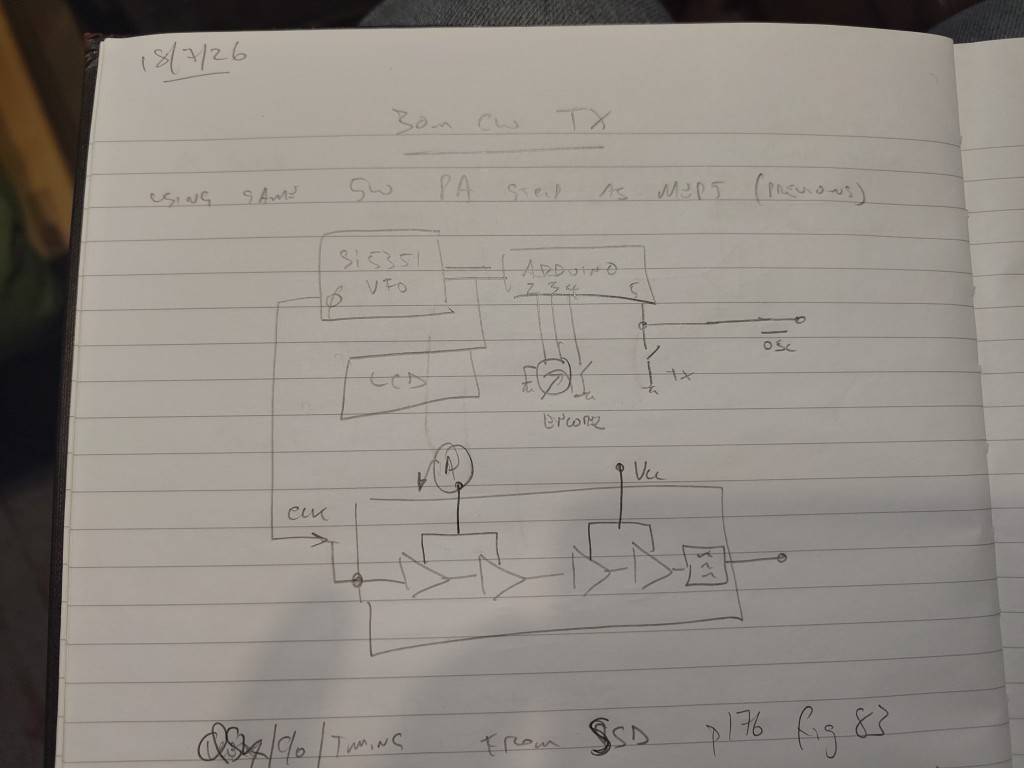
I'm embracing some of the spirit of the 1960/70/80 SWM articles, and also keeping up to date with //some// modern-day developments (e.g Arduinos and SI5351 VFOs) but blending them with older technologies - simple superhet and Direct Conversion receivers and CW transmitters that don't need to be terribly complicated.
The key is not to dismiss everything new, but also not to dismiss the huge back-history of designs and techniques.
And for me it's now to migrate myself back to where I first wanted to be in the hobby. What I first thought the hobby was about. Based on my early brainwashing from those SWMs.
The more I re-read them and the more I ponder what I want to get from my time in the shack, the more I want to melt solder, build little circuits and play radio. With the emphasis on PLAY....