Gopher

My Gopher Hole

Quite some time ago I delved into the realm of Gopher - the internet protocol that pre-dated WWW and that quickly became extinct thereafter.

Gopher is a simple protocol and mostly serves simple text files, but can "deliver" other types of files (images, sound etc). What it doesn't do is allow formatting within a text file, it's just plain text, no markup, no "rendering" and significantly no inline images and no embedded hyperlinks.

You can have a menu (aka gophermap) that has selectors - links to other resources which can be local to this gopher server or remote on another gopher server. It all looks like one distributed filesystem.

There's been a resurgence of interest in "small-web" protocols lately - simple HTML-only personal websites, simple self-hosted blogs (like this one) and alternative protocols like Gopher and the newer Gemini.

Gopher space is different to the Web. And there are people who only post/publish on Gopher. There are people who publish on Gopher and the web simultaneously and others that choose the platform for a post depending on its content.

I toyed a while ago about ditching all my WWW sites - blog, dokuwiki, webpages (such as they are) - and only put things on Gopher, to keep away from the nasty WWW.

Yes, the WWW is now a largely user-hostile environment. Awash with advertising and tracking and search engines that spy and only provide search results that are designed to lead to commercial sites, and to put adverts infront of your eyeballs... and AI....

But, I also find that, for example, in the Ham Radio niche that there are still personal websites containing people's ideas, experiments, projects, shared knowledge and experience. No AI, no monetization. Just good old personal "small-web" websites. They DO still exist... but it takes effort to find them

We need to curate our own list of sites we're interested in. And follow breadcrumb trails from site to site - bookmarking them manually as we go - and avoid AI-riddled search engines. Pretend it's pre-G*^gle days. When search engines were cr&p and you had to use your intuition and follow your own path through cyberspace, mapping it as you went.

And Gopher is still a valuable part, I think, of the experience for me. I can write stuff there that will only be found and read by real people who are themselves travelling in Gopherspace, mapping it and remembering which Gopherholes they enjoy, and want to keep visiting.

I will post things in both places - here on a Blog if it's radio-related and especially if it requires pictures to really convey the content - and on Gopher if it's words-only. I may post some things in both places.

My Gopherhole:

gopher://g4slv.cloud:70/

Next project will be for 20m

The next band

I'm deciding which band to build my new transceiver for and initially thought I'd go for 17m. But it's

  • a band I've not used in the past and am only interested in it as somewhere new to explore
  • it's not going to be open for large periods of the day
  • I think 20m will give more opportunities to have QSOs at the random times of day I get to operate

I thought I'd get more use from 20m, and leave a 17m for another project in the future.

I have 20m at the moment through the QMX (80/60/40/30/20) but I'd like to move to 100% homebrew (i.e. homebrew-from-scratch) one day so why not start replacing the bands available in kits and start with 20m?

Antenna

My "experimental" (isn't everything in this hobby temporary and experimental?) trapped end-fed half-wave inverted-L was initially built for 30m and 40m with a single 10.1MHz trap. It seems to work nicely and it's great to be able to switch bands without having to use an ATU etc.

Yesterday I made a 2nd trap for the antenna - resonant on 14.0MHz - using a 56pF mica capacitor and toroid inductor of ~20T on T80-2 (red). Adding the trap to cut the already resonant 30m section in two took a lot of time. The normal way to make a trapped antenna is to make the highest frequency segment resonant first, then add the first trap (resonant for that band). The next lowest segment is added and trimmed to length.... etc....

Adding a new trap inside the first segment throws the resonance of the longer parts off... I found I had to first trim the 20m segment to resonance and I'd initially cut the 30m segment in the wrong place (the 20m section was too long) so I had to trim it.... which then meant that when adding the 20m trap the rest of the antenna I found that the next resonance (for 30m) was too high (the 30m segment was now too short) so I had to add length back to get the 30m resonance right. Fortunately this made no difference to the overall resonance on 40m.

I now have a 3-band no-tune End-Fed Half-Wave for 20m/30m/40m

Next steps

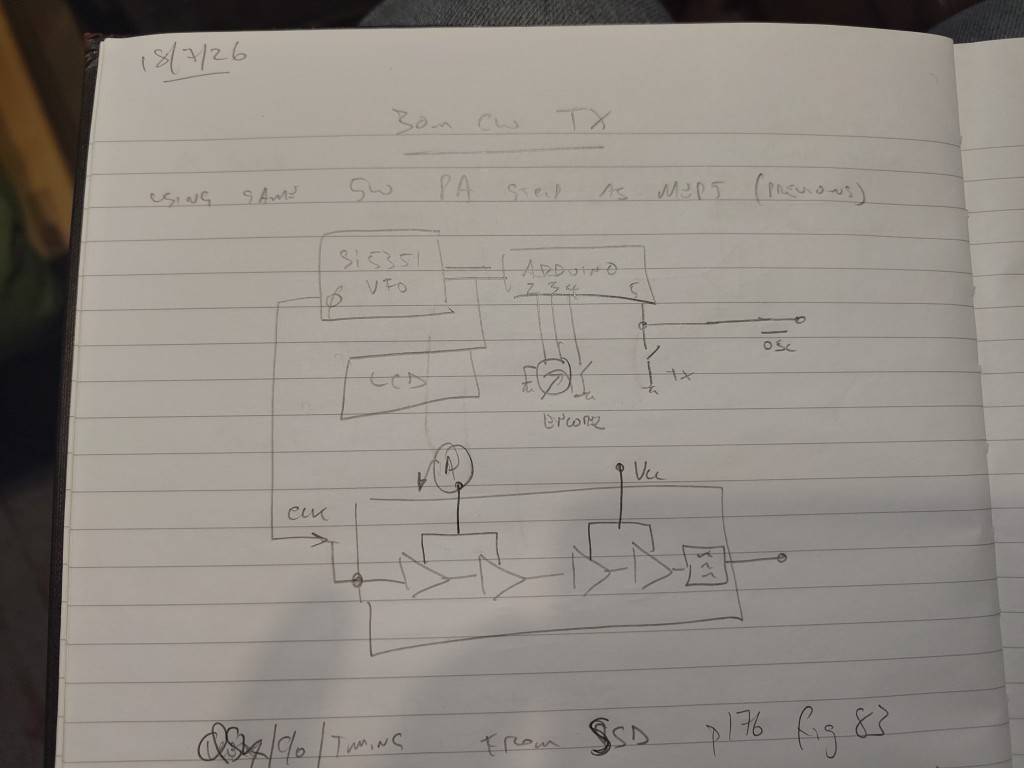
I plan to build a CW transceiver for 20m with a superhet RX using an NE602 as the first mixer and a simple CW transmit strip with an IFR510 as the final amplifier for ~5W CW. I'll use a single arduino & SI5351 clock to generate the 3 signals needed First Local osc for RX, BFO for RX and TX carrier.

More test gear for the lab

I have been retrieving more gear from my old shack in the shed, trying to save it from the inevitable decay from being left un-powered and unused for so long!

I've set up the HP640B signal generator and a Rapco 1804B GPS-locked 10MHz frequency source. I'm amazed and very happy that they both still work.

The 8640B took an hour or two to fully warm up and for the slow drift to settle down. Now it's been on for 6 hours it seems very stable.

The Rapco GPS-locked frequency source took a couple of hours to change state to "Control On" - i.e. the red LED "Control Off" extinguished.

This means I can use the 10MHz reference to keep the following items in sync:

  • Marconi 2022D signal generator
  • Siglent SDG 1032X function generator
  • Rigol DSA 815 spectrum analyzer

I also found a mysterious die-cast box in a junk box in the shed and looking inside I see it's a divide-by-two circuit I built to generate a 5MHz reference for the HP8640B, derived from the 10MHz GPS source

and it works...

using this I can feed the HP8640B external counter timebase reference input, so that its counter is locked to a GPS source. This doesn't discipline the HP8640B generator, but means that the frequency counter is accurate, and therefore the generator can be set pretty accurately. This also means that the "LOCK" function which phase-locks the generator to the counter will hold the frequency stable (within the limits of how far the analogue generator drifts before it exceeds the lock range) and be accurate, since the counter is accurate.

I left the HP8640B on 10.100000MHz, and with the "LOCK" turned on for over an hour and it remained LOCKED. That's probably good enough.

I can now measure pretty much all I need to for normal homebrewing activities, with 2 RF signal generators, 1 general function generator (AF and RF), dual-channel Digital Storage Scope, Spectrum Analyzer tracking generator, nanoVNA, several Fluke DMMs, a couple of old AVO 8 analogue multimeters. QRP power measurement might be the next thing I should investigate. At the moment I have a simple SWR meter, reasonably accurate with a 5W scale, and also some good 50 ohm loads and the scope mean I can get fairly good power measurements already.

Superhet Project #1

The Crystal Filter

The plan is to build a simple single-conversion superhet using NE602 as the first mixer, and perhaps also as the second mixer (demodulator), although I might save my small supply of NE602 chips and use a simple home-made diode ring mixer as the detector.

I need an IF filter and plan to try different methods over time, starting simple with a crystal filter of the type that was common until the 1960s...

I rummaged through my component drawers and found very few suitable crystals to use in a first experiment. There were two marked 3496kHz (large case, HC50/U ?) and two small 27MHz. I didn't really want a 27MHz IF, so I went with the 3MHz crystals.

The first iteration of the filter is the design above

I initially tried sweeping it with my Rigol DSA815 Spectrum Analyzer/Tracking Generator - and it looked rubbish... until I realized that I needed to severely reduce the resolution bandwidth... which greatly slowed the sweep rate... and after a while I gave up and swapped to the NanoVNA, which instantly showed the swept response I was expecting, with a sharp peak and a deep notch to one side or other of the passband peak. .

Adjusting the trimmer moves the position of the notch. I decided to find an adjustment that gave a symmetrical response either side of the peak, moving the notch well away LF

The impedance match was okay without additional input matching - the return loss around 23dB with a |Z| of around 59 ohms.

Passband Measurements

Insertion Loss : 1.56dB

3dB Bandwidth : 182Hz

6dB Bandwidth : 318Hz

Half Lattice

I also tried a half-lattice arrangement

and found that the stop-band attenuation was much greater. The input & output impedances became around 20 ohm and I made small auto-transformers on FT37-43

and the input and output matches became better than 18dB.

The response was sharper and I'm not sure how it would sound in a real receiver, and I didn't take any quantitative measurements. For a half-lattice filter I think the xtals should be on slightly different frequencies to give a more defined shape to the passband, rather than a simple peak.

My plan is to use the single-crystal filter at first and see how it performs, and how it sounds on CW signals.

The next iteration should really be a ladder filter of some kind.

Next Projects

After building a QCX-mini for 40m a few years ago, and a QMX (mini) very recently I decided a few weeks ago to build a QCX+ for 30m to use as my main shack rig, for my main band of 30m.

In the intervening weeks since ordering the QCX+ kit from QRPLabs I finished some old projects that were hanging about in my junk box - a 30m phasing RX and a 30m CW TX - and this combination of separates has become my "main shack rig" for 30m.

The QCX+ kit seems a little redundant now, as I try to move myself away from commercial rigs and into the realm of the 100% homebrewer... but I still would like the fun and experience of building it and having it as an addition to the shack. My self-inflicted "rules" are that I should only use transmitters I've "built" myself - and a kit is still acceptable. So I'm planning to put it aside until I have a free weekend with no other homebrew projects on the go, and I'll build it and add it to the array of 30m rigs in the shack.

My next project is still under consideration - it's likely to be a CW RX for 17m - a band I've never really used but might be fun to try - and this time it'll be a simple superhet1. I'll use it as a test bed for trying different forms of IF crystal filters, starting at a simple "single crystal-with-phasing capacitor" that harks back to the olden-days. This RX also might feature an NE602 or 2 since I've got a few and don't remember ever using one before.


  1. I don't want to go through a full "quadrature phasing RX" build again!

    ↩︎